Prime Minister Narendra Modi’s trips demonstrate India’s commitment to connect with other nations of the Global South.
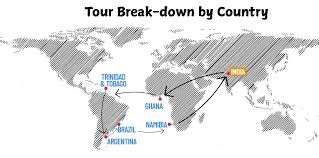
Context: The Prime Minister’s recent high-profile five-nation tour, encompassing Ghana, Trinidad and Tobago, Argentina, Brazil, and Namibia, marks a significant diplomatic push. It underscores India’s evolving foreign policy, which increasingly pivots on multi-alignment, strategic autonomy, and a quest for partnerships to fuel its domestic transformation. This tour was not a series of disconnected bilateral visits but a coherent strategic outreach to key partners across different continents, reflecting India’s ambition to position itself as a ‘Vishwa Mitra’ (friend to the world) and a leading power.
- With Japan, the focus was on strengthening the Quad, enhancing maritime security in the Indo-Pacific, and building a rules-based order to counter regional hegemonic tendencies.
- The visit to Vietnam, a key ASEAN partner, reinforced India’s ‘Act East’ policy, with discussions centred on defence cooperation and ensuring freedom of navigation in the South China Sea.
- In the UAE, the engagement went beyond energy, cementing its role as a cornerstone of India’s West Asia policy and a partner in new groupings like the I2U2 (India, Israel, UAE, USA).
- With Germany, a powerhouse in the European Union, talks revolved around reforming multilateral institutions like the UN Security Council and coordinating positions on global conflicts.
- Finally, the stop in Brazil reaffirmed India’s commitment to the Global South, strengthening platforms like BRICS and IBSA (India, Brazil, South Africa) as crucial voices for developing nations.
- This multi-directional engagement demonstrates India’s strategy of multi-alignment—working with diverse partners, from the West to the Global South, without being locked into a single camp, thereby preserving its strategic autonomy.
- Technology and Capital: Engagements with Germany and Japan aimed at securing high-technology and capital for India’s infrastructure and manufacturing sectors, including semiconductors and high-speed rail.
- Supply Chain Diversification: Vietnam, a crucial node in global supply chains, was positioned as a key partner in India’s “China-Plus-One” strategy, aiming to reduce economic dependence on a single country.
- Energy and Trade Hub: The UAE visit focused on consolidating the gains from the Comprehensive Economic Partnership Agreement (CEPA) and ensuring India’s long-term energy security, while also positioning the UAE as a gateway for Indian businesses to Africa and Europe.
- New Markets: With Brazil, discussions explored expanding trade in agriculture, pharmaceuticals, and automotive components, seeking deeper access to the Mercosur market.
- Digital Public Infrastructure (DPI): India showcased its success in DPI, like the UPI platform, as a model for other nations, fostering partnerships for a global digital commons.
- Green Transition: A major focus with Germany was the Green and Sustainable Development Partnership, particularly collaboration on green hydrogen and renewable energy, crucial for India’s climate goals under its updated Nationally Determined Contributions (NDCs).
- People-to-People Ties: Across all nations, cultural exchanges and agreements to ease mobility for students and professionals were emphasized to strengthen the foundational layer of these bilateral relationships.
- While the tour has set an ambitious agenda, its success hinges on overcoming significant challenges. The primary challenge is the implementation deficit—the gap between agreements signed and their on-ground execution. Bureaucratic hurdles and policy inconsistencies can deter potential investors.
- Furthermore, India’s balancing act will become increasingly complex. Engaging deeply with the US-led Quad while simultaneously championing the voice of the Global South through BRICS requires deft diplomacy and a clear articulation of India’s interests.