Loyalty and Ladakh: Regarding the detention of Sonam Wangchuk
Discussions that occur while Sonam Wangchuk remains incarcerated will lack credibility
Introduction
The recent detention of renowned innovator and social activist Sonam Wangchuk in Ladakh under the stringent National Security Act (NSA) has cast a sharp spotlight on the escalating tensions in the ecologically fragile and strategically significant region. The move, following violent protests demanding statehood and inclusion in the Sixth Schedule of the Constitution for Ladakh, has ignited a fervent debate on the balance between national security and the democratic aspirations of a region that has long prided itself on its unwavering loyalty to the nation. This article delves into the multifaceted dimensions of the issue, exploring the historical context of Ladakh’s demands, the immediate triggers for the unrest, and the broader implications for governance and security in the sensitive border region.
The Genesis of a Movement: From Union Territory to a Quest for Statehood
For decades, a significant section of Ladakh’s populace has harbored aspirations for greater autonomy to protect their unique cultural identity, fragile environment, and economic interests. Initially a part of the erstwhile state of Jammu and Kashmir, Ladakh was granted the status of a Union Territory in August 2019, a move that was largely welcomed by the Buddhist-majority region. This decision was seen as a step towards fulfilling their long-standing demand for a distinct administrative identity, separate from the Kashmir valley.
However, the initial euphoria soon gave way to a growing sense of disillusionment. The administration under a Lieutenant Governor was perceived by many as being disconnected from the local populace and their developmental needs. Concerns began to mount over the potential for demographic change, the exploitation of natural resources by external entities, and the erosion of the unique Ladakhi way of life. It is in this context that the demand for full statehood and, crucially, inclusion under the Sixth Schedule of the Constitution, gained significant momentum.
The Sixth Schedule: A Shield for Tribal Identity
The Sixth Schedule of the Indian Constitution provides for the administration of tribal areas in certain northeastern states, allowing for the formation of autonomous districts and regional councils with powers to make laws on a variety of subjects, including land, forests, and social customs. For the people of Ladakh, with its predominantly tribal population, inclusion under this schedule is seen as a vital safeguard for their distinct cultural and ecological heritage. It would empower local communities to have a greater say in their own governance and development, ensuring that progress is aligned with their traditional values and environmental sensitivities.
Sonam Wangchuk and the Escalation of Protests
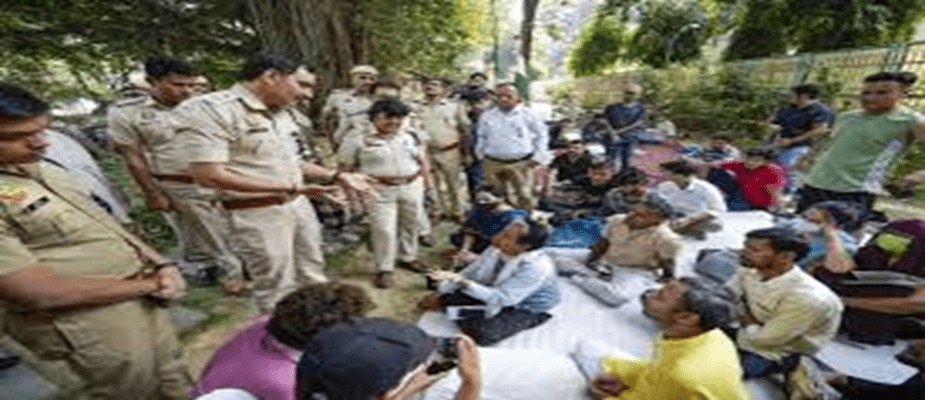
Sonam Wangchuk, an internationally acclaimed innovator and a respected voice from Ladakh, emerged as a prominent figure in articulating these demands. Through a series of fasts and peaceful protests, he sought to draw national attention to the anxieties of the Ladakhi people. The movement, initially peaceful, took a violent turn on September 24, 2025, when protests in Leh resulted in clashes with security forces, leading to unfortunate fatalities and injuries.
The government has accused Wangchuk of instigating the violence, a charge his supporters vehemently deny, insisting that his methods have always been peaceful and Gandhian. His subsequent detention under the NSA on September 26, 2025, has been widely criticized by opposition parties and civil society groups as a high-handed measure to stifle dissent. The government’s actions, which also included the suspension of internet services and the imposition of a curfew, have further deepened the trust deficit between the administration and the people of Ladakh.
The Government’s Perspective and the National Security Angle
From the government’s standpoint, the developments in Ladakh are viewed through the prism of national security. Situated at a critical juncture with borders adjoining both China and Pakistan, the stability of Ladakh is of paramount importance. The government has emphasized the need to maintain law and order and has pointed to alleged foreign links in some of the protests, a claim that has been refuted by Wangchuk’s family.
Furthermore, the government has highlighted the significant financial investments and developmental projects initiated in Ladakh since it became a Union Territory. It argues that these initiatives are aimed at improving the lives of the local population and that the ongoing agitation is politically motivated. The revocation of the Foreign Contribution (Regulation) Act (FCRA) license of an educational NGO co-founded by Wangchuk is also seen as part of a broader crackdown on entities perceived to be acting against the state’s interests.
Conclusion: The Path Forward
The detention of Sonam Wangchuk and the ongoing turmoil in Ladakh present a complex challenge that requires a nuanced and empathetic approach. While the government’s security concerns in a sensitive border region are understandable, the legitimate aspirations of the people of Ladakh for the protection of their identity and a greater say in their own affairs cannot be ignored. A purely administrative or security-centric approach is unlikely to yield a lasting solution.
The need of the hour is a sincere and sustained dialogue between the central government and the representatives of the Ladakhi people. Addressing the core demands for constitutional safeguards under the Sixth Schedule and exploring a viable roadmap for greater autonomy are crucial steps towards rebuilding trust and restoring normalcy. The loyalty of the people of Ladakh has been a steadfast asset for the nation; this must be reciprocated with a governance model that is inclusive, responsive, and respectful of their unique identity and aspirations. The path to a secure and prosperous Ladakh lies not in suppression, but in a meaningful partnership built on mutual trust and respect.
UPSC mains exam question based on the provided topic:
GS Paper 2: Governance, Constitution, Polity
- Indian Constitution: Features, amendments, and significant provisions. Functions and responsibilities of the Union and the States, issues and challenges on the federal structure, devolution of powers and finances up to local levels, and challenges therein. Separation of powers between various organs, dispute redressal mechanisms, and institutions. Pressure groups and formal/informal associations and their role in the Polity. Statutory, regulatory, and various quasi-judicial bodies.
GS Paper 3: Security
- Security challenges and their management in border areas – linkages of organized crime with terrorism. Linkages between development and the spread of extremism. Role of external state and non-state actors in creating challenges to internal security.
Question 1. The demand for inclusion in the Sixth Schedule for Ladakh reflects a deeper aspiration for preserving unique cultural identity and securing developmental rights. Critically analyse the constitutional basis and administrative feasibility of this demand. In this context, discuss how the detention of a prominent activist under the National Security Act (NSA) impacts the delicate balance between democratic aspirations and state security. (250 words, 15 marks)
Question 2. The recent unrest in Ladakh, a strategically vital border region, underscores the complex linkage between internal security and the developmental aspirations of local populations. Examine the security challenges in border areas arising from a perceived disconnect between administration and the people. Suggest a comprehensive strategy to balance national security imperatives with the need for inclusive governance to ensure the loyalty and cooperation of the local populace. (250 words, 15 marks)
(Source – The Hindu)