Generational anger: Regarding the turmoil in Nepal
The rise of violent nihilism in the wake of government repression poses a significant threat to democracy in Nepal
Introduction:
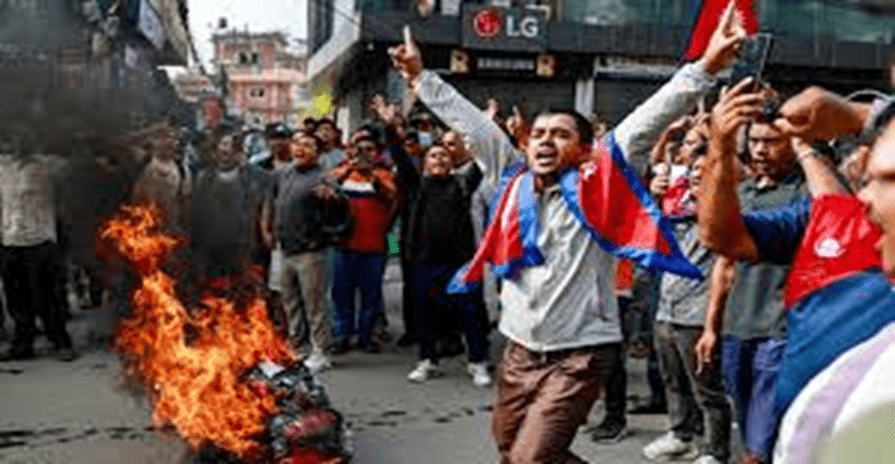
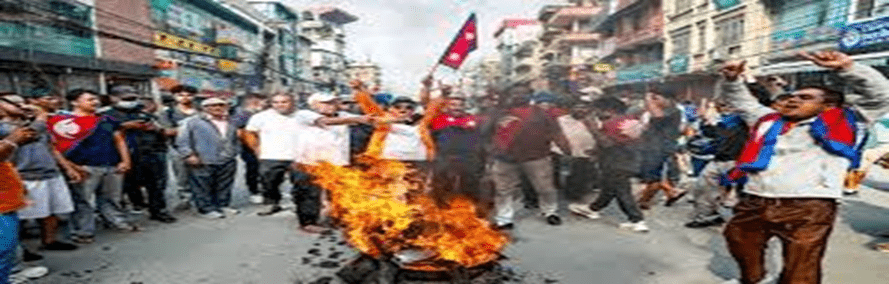
Nepal is grappling with a severe political crisis, marked by violent youth-led protests that have shaken the foundations of its nascent democracy. The recent upheaval, which saw the torching of significant government buildings and the resignation of Prime Minister K.P. Oli, is a manifestation of deep-seated “generational rage” against a political establishment perceived as corrupt, self-serving, and disconnected from the aspirations of the youth. This article, based on “The Hindu” editorial “Generational rage: On the upheaval in Nepal,” delves into the multi-faceted dimensions of this crisis, examining its causes, implications, and the uncertain path ahead for the Himalayan nation.
The Anatomy of a Crisis: Political, Social, and Economic Dimensions
At its core, the turmoil in Nepal is a product of chronic political dysfunction that has plagued the nation for decades. Since the transition to a democratic republic, Nepal has witnessed a revolving door of governments, with 13 heads of government across 30 tenures since the 1990s. This instability has fostered a political culture where leaders of mainstream parties like the Nepali Congress, CPN-UML, and CPN-Maoist Centre have been accused of prioritizing power politics over governance and public welfare.
This political decay is deeply intertwined with socio-economic grievances. Widespread corruption, impunity for those in high office, and blatant nepotism have fueled a sense of hopelessness among the youth. The ostentatious lifestyles of the political elite, often flaunted by their children (“Nepo kids”), stand in stark contrast to the struggles of ordinary citizens grappling with unemployment and the need to seek opportunities abroad. The government’s recent ban on certain social media applications, citing non-compliance with Nepali law, proved to be a significant miscalculation and the immediate trigger for the widespread protests. This move was perceived as an authoritarian attempt to stifle dissent and further alienated a generation that is digitally connected and politically aware.
The heavy-handed government crackdown on initial demonstrations, which resulted in the death of 19 young protestors, poured fuel on the fire, transforming simmering discontent into a violent outburst. The subsequent acts of arson and the release of prisoners represent a dangerous slide into “violent nihilism” that threatens to undo the democratic gains achieved through struggles like the “Jan Andolan II” of 2005.

The Rise of New Political Actors and the “Gen Z” Protests
The ongoing upheaval is distinct in its leadership and character. It is largely a leaderless, decentralized movement, driven by “Gen Z” – a generation that has grown up in a digital world and is less tolerant of the traditional, clientelistic politics of their predecessors. This youth-led movement has found a voice in new and alternative political formations like the Rashtriya Swatantra Party and independent figures such as Kathmandu’s popular mayor, Balendra Shah. The rise of these new voices reflects a genuine public desire for change and a rejection of the established political order.
However, the emergence of these new actors also presents its own set of challenges. Some of their stances, such as Mr. Shah’s call to dissolve the elected Parliament rather than advocating for a caretaker government and fresh elections, have raised concerns about their democratic maturity and commitment to constitutional norms. The situation draws parallels with recent events in Bangladesh, serving as a cautionary tale against the potential for democratic backsliding when state institutions are undermined.
Challenges to Democracy and the Way Forward
The current crisis poses a grave threat to Nepal’s democracy. The destruction of state and civil society institutions is not a sign of democratic renewal but a descent into anarchy. There is a pressing need to restore order and create a space for civilian democratic actors to reassert control. In this context, the role of the Nepali Army becomes crucial in ensuring stability without overstepping its constitutional bounds.
The long-term solution, however, lies in fundamental political and constitutional reforms that address the root causes of the current unrest. The promises of a “Naya Nepal,” made during the Constituent Assembly process but diluted in the final constitution, need to be revisited. A potential reform could be the introduction of a presidential system with a directly elected head of government, accountable to the Parliament, which could help break the cycle of political instability.
Conclusion:
The “generational rage” engulfing Nepal is a stark reminder that democracy is not merely about holding elections but about delivering good governance, ensuring accountability, and fulfilling the aspirations of the people, especially the youth. While the immediate priority is to restore peace and order, the political leadership, both old and new, must engage in sincere introspection and dialogue to chart a path towards meaningful reform. The future of Nepal’s democracy hinges on their ability to address the deep-seated frustrations of a generation that has run out of patience with the status quo. The alternative is a dangerous slide into chaos that could have far-reaching consequences for the nation and the region.
UPSC Mains Exam Question based on the Provided Topic:
GS Paper 2: India and its Neighborhood- Relations.
- Understanding the internal political and social dynamics of a neighboring country like Nepal is crucial for this syllabus area. Political instability, its causes, and its nature directly impact India’s foreign policy, security, and economic interests in the region. This question tests the candidate’s ability to analyse the domestic factors that could lead to instability on India’s border.
GS Paper 1: Social Issues – Role of youth.
- The question directly addresses the theme of youth-led protests and social unrest (“generational rage”), which falls under the study of social issues and the role of different demographics in shaping national events.
Question 1: “The recent upheaval in Nepal is described as a manifestation of ‘generational rage’. In this context, analyse the key political, economic, and social factors that have fueled this youth-led crisis. (150 words, 10 Marks)”
Question 2: “The rise of new political actors amidst the recent turmoil in Nepal signals a rejection of the old guard, yet it also presents challenges to its democratic future. Discuss. In your opinion, what constitutional and political reforms are necessary to steer Nepal towards stability? (250 words, 15 Marks)”
(Source – The Hindu)