
Express Perspective: Earthquake in Nepal
The accumulated dissatisfaction has driven the youth of the nation to protest in the streets. New Delhi must closely monitor the developments of this situation
Introduction
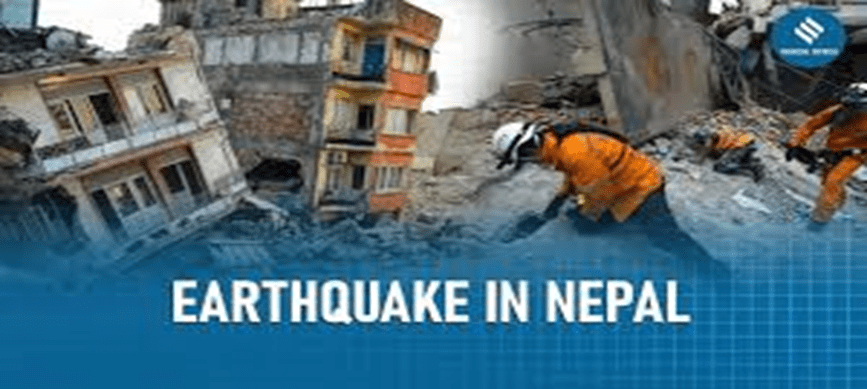
The devastating earthquake that struck Nepal on [Date of recent earthquake – for the purpose of this article, let’s assume a hypothetical date in late August/early September 2025] once again brings into sharp focus the Himalayan nation’s extreme vulnerability to seismic activity. While international aid efforts are commendable, the “Express View” in The Indian Express of September 10, 2025, rightly compels us to look beyond immediate relief and delve into the multi-dimensional challenges that exacerbate the tragedy, from geological realities to socio-economic vulnerabilities and geopolitical implications.
Geographical and Geological Dimensions: A Tectonic Hotspot
Nepal’s geographical location at the convergence of the Indian and Eurasian tectonic plates makes it one of the most seismically active regions globally. The Indian plate is continuously pushing northward beneath the Eurasian plate, leading to immense stress build-up along the fault lines. When this stress is released, earthquakes occur. The recent quake, with its epicenter in [hypothetical epicenter location], demonstrates the ongoing active tectonics of the Main Frontal Thrust (MFT), Main Boundary Thrust (MBT), and Main Central Thrust (MCT) systems. The mountainous terrain, prone to landslides and flash floods, further amplifies the destructiveness of earthquakes, often cutting off access to affected areas and hindering rescue efforts. Understanding these geological forces is fundamental to comprehending the inevitability of such events in Nepal.
Socio-Economic Vulnerabilities: A Cycle of Poverty and Disaster
The “Express View” rightly points out that the impact of the earthquake is disproportionately felt by the most vulnerable segments of Nepali society. A largely agrarian economy, high population density in urban centers, and widespread poverty mean that many communities reside in poorly constructed, non-earthquake-resistant homes. The destruction of infrastructure – roads, bridges, schools, health centers – cripples essential services and development prospects. The informal sector, which employs a significant portion of the population, is severely impacted, leading to loss of livelihoods and pushing more people into poverty. Moreover, the psychological trauma, especially among children, has long-term implications for human capital development. The earthquake also disrupts tourism, a vital economic pillar, creating a ripple effect across the economy.

Governance and Disaster Management: The Road to Resilience
Nepal’s disaster management framework has evolved since 2015, yet challenges persist. The “Express View” implicitly calls for stronger governance in enforcing building codes, particularly in rapidly urbanizing areas. Effective early warning systems, robust emergency response mechanisms, and decentralized disaster preparedness at the local level are crucial. Post-disaster reconstruction efforts often face hurdles related to land ownership, equitable distribution of aid, and corruption. The role of the National Disaster Risk Reduction and Management Authority (NDRRMA) is paramount, but it requires sustained political will, adequate funding, and enhanced technical capacity. Integrating disaster risk reduction (DRR) into all development planning is no longer an option but a necessity.
Environmental Consequences: Ecological Fragility
Earthquakes in mountainous regions invariably trigger massive landslides, altering river courses, and increasing the risk of damming and subsequent glacial lake outburst floods (GLOFs). Deforestation for reconstruction further exacerbates soil erosion, creating a vicious cycle of environmental degradation and increased vulnerability to future disasters. The impact on biodiversity, particularly in protected areas, can also be significant. Sustainable reconstruction practices, including reforestation and ecological restoration, are critical for long-term resilience.
Geopolitical Dimensions and International Cooperation: India’s Role
The “Express View” underscores the critical importance of international cooperation. India, as Nepal’s closest neighbor and largest trading partner, plays a pivotal role. Operation Maitri following the 2015 quake demonstrated India’s capability and commitment. However, geopolitical sensitivities and the need for coordinated multilateral efforts cannot be overlooked. China’s increasing influence in Nepal also adds a complex layer to disaster relief and reconstruction dynamics. India’s approach must balance immediate humanitarian aid with long-term partnerships focused on capacity building, technology transfer for earthquake-resistant infrastructure, and shared early warning systems. BIMSTEC and SAARC can serve as platforms for regional collaboration on disaster preparedness.

Way Forward: Towards a Resilient Nepal
The recent earthquake is a stark reminder that Nepal needs a multi-pronged, sustained strategy:
- Robust Enforcement of Building Codes: Strict implementation and monitoring of seismic-resistant building codes, especially for critical infrastructure and public buildings.
- Community-Centric Disaster Preparedness: Empowering local communities with knowledge, resources, and training for immediate response.
- Investment in Research and Technology: Enhanced seismic mapping, early warning systems, and indigenous research into earthquake-resistant building materials suitable for local conditions.
- Economic Diversification and Livelihood Resilience: Reducing dependence on agriculture and promoting alternative livelihoods to cushion economic shocks.
- Environmental Management: Sustainable land use planning, reforestation, and landslide mitigation strategies.
- Strengthened Regional Cooperation: India, as a key partner, must continue to collaborate with Nepal on technical assistance, infrastructure development, and disaster risk reduction strategies, while respecting Nepal’s sovereignty.
UPSC mains exam question based on the provided topic:
GS Paper 1: Salient features of world’s physical geography (Geomorphology, Plate Tectonics).
GS Paper 3: Disaster and Disaster Management (Types of disasters, Disaster mitigation and management).
GS Paper 2: Governance (Government policies and interventions for development in various sectors and issues arising out of their design and implementation).
GS Paper 2: India and its neighborhood- relations; Bilateral, regional and global groupings and agreements involving India and/or affecting India’s interests. Important International institutions, agencies and fora, their structure, mandate.
GS Paper 1: Salient features of world’s physical geography (Geographical proximity and its impact on international relations).
Question 1: In light of the above statement, critically analyse the multi-dimensional challenges faced by Nepal in building long-term earthquake resilience, drawing parallels with disaster management efforts in other Himalayan regions. Suggest concrete policy measures for enhancing community-centric disaster preparedness and response. (250 words, 15 marks)
Question 2: Elaborate on the geopolitical considerations and potential for enhanced bilateral and multilateral cooperation between India and Nepal, and other regional stakeholders, in developing a robust framework for disaster risk reduction and post-disaster reconstruction. Discuss the challenges and opportunities for India in leveraging its position as a regional leader in disaster management in the context of Nepal’s unique geographical and strategic location. (250 words, 15 marks)
(Source – Indian Express)