
In typical circumstances, the repatriation of funds by foreign multinationals and the overseas investments made by Indian corporations should not raise any alarms for a vast and open economy such as India
Context: The article “Direct influence: The dynamics of foreign investment require thorough examination” underscores a critical juncture in India’s engagement with global capital. While foreign investment (FI), particularly Foreign Direct Investment (FDI), remains a vital engine for economic growth, its evolving nature and potential for exerting “direct influence” necessitate a more nuanced and comprehensive assessment beyond mere quantum.
- Capital Infusion: FI bridges the domestic savings-investment gap, crucial for infrastructure development and industrial expansion.
- Technology Transfer & Skill Upgradation: FDI often brings advanced technologies, managerial expertise, and best practices, enhancing productivity and upskilling the local workforce.
- Employment Generation: New ventures and expansion of existing ones through FI create direct and indirect employment opportunities.
- Enhanced Competitiveness & Market Access: FI fosters competition, leading to improved efficiency and innovation. It can also integrate domestic firms into global value chains.
- Balance of Payments Support: Inflows of foreign capital help stabilize the BoP, especially when export earnings are volatile.
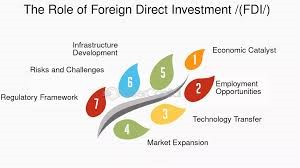
- Investment in critical infrastructure (ports, power, telecom), sensitive technologies (AI, biotech, defence), and data-heavy sectors can pose national security risks if dominated by entities from potentially adversarial nations or those with opaque ownership structures.
- The origin of investment, especially state-backed or state-influenced capital, requires scrutiny for potential geopolitical leverage or intelligence gathering.
- Large foreign corporations, with their significant financial muscle, can potentially influence domestic policymaking to favor their interests, sometimes at the expense of domestic industry or the public good.
- This can manifest in lobbying for favorable tax regimes, diluted environmental standards, or skewed competition policies.
- While competition is healthy, unfettered FI, especially “brownfield” (acquisitions), can sometimes lead to the crowding out of nascent domestic players, particularly MSMEs, before they can achieve scale.
- The quality of FDI matters – investments that merely acquire market share without substantial value addition (R&D, local sourcing) may offer limited long-term benefits.
- Over-reliance on certain types of FI, especially Foreign Portfolio Investment (FPI), can expose the economy to global financial shocks and sudden capital flight, impacting currency stability and financial markets.
- Repatriation of profits, while a legitimate right of investors, can also strain the BoP if not balanced by sustained new inflows and export growth.
- Foreign investors may not always adhere to the highest ESG standards, potentially leading to labor exploitation, environmental degradation, or displacement issues if not robustly regulated and monitored.
- Robust screening of FDI proposals, especially in sensitive sectors and from “countries of concern,” based on transparent criteria (like India’s Press Note 3, 2020).
- Enhanced due diligence on beneficial ownership and source of funds.
- Incentivizing investments that bring in cutting-edge technology, foster R&D, create high-quality jobs, and integrate with local supply chains.
- Focus on attracting greenfield investments and those aligned with national priorities like Make in India, Atmanirbhar Bharat, and green transition.
- Calibrating policies to support domestic industries, especially MSMEs, to compete effectively.
- Strong enforcement of competition laws to prevent market dominance by foreign entities.
- Negotiating BITs that are balanced, protecting investor rights while preserving the host state’s regulatory space and national interests.
- Seeking reciprocal market access for Indian investors abroad.
- Maintaining transparency in approval processes and policy formulation regarding FI.
- Engaging with civil society and domestic industry to understand concerns and incorporate feedback.